
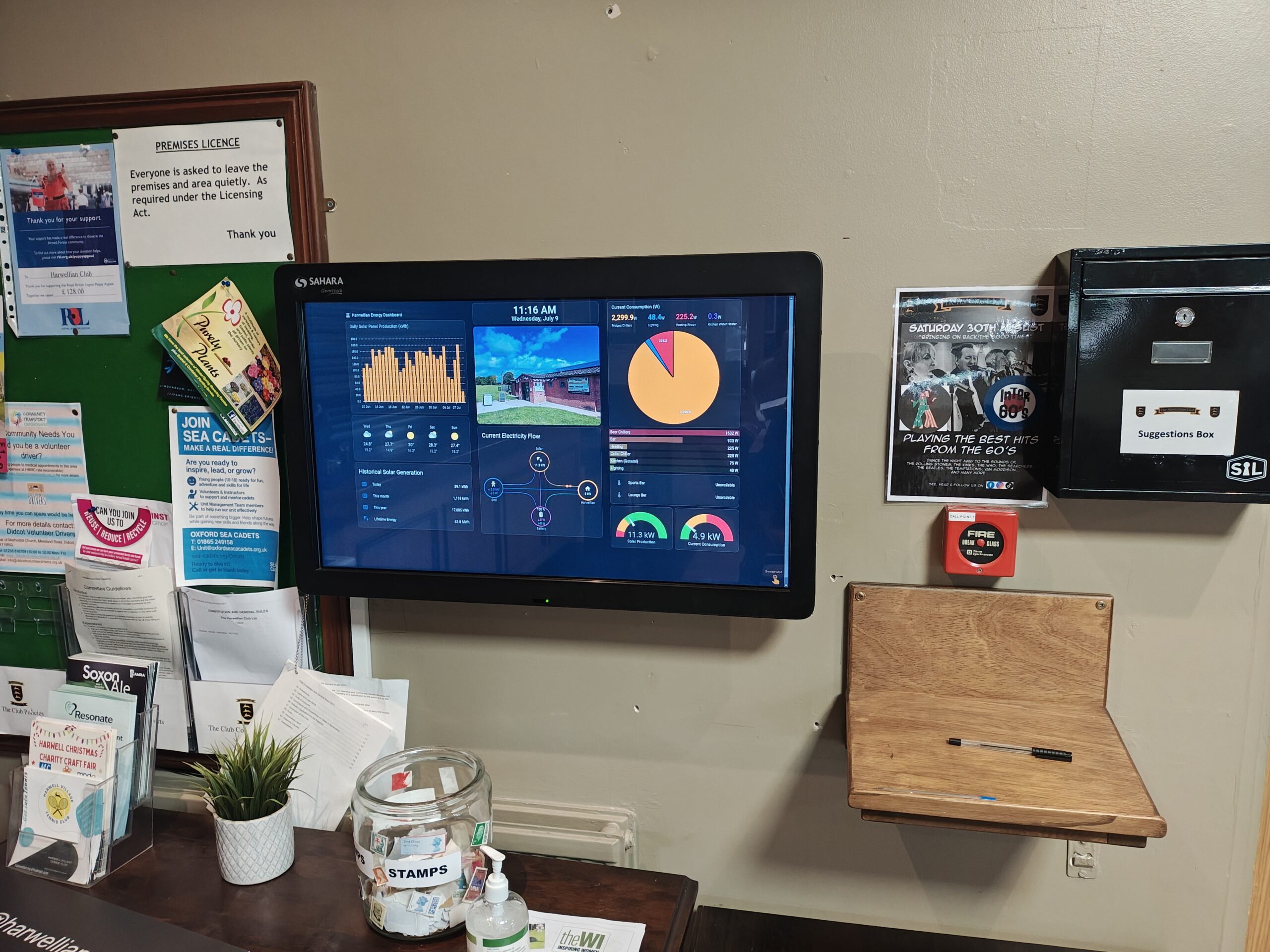
This energy dashboard situated in the club displays information about our energy consumption.
Consumption information is gathered by various sensors located around the club, and is stored in a database. We use this energy information to enable us to identify areas where we may be able to reduce our consumption and thereby reduce our carbon footprint and our running costs.
The dashboard highlights our focus on energy conservation and our efforts towards sustainability. The dashboard is displayed in the public area for general information and hopefully inspiration – we hope it will encourage everyone to think about their own energy usage and how to reduce it.
Background to the energy monitoring project
One of our motivations for setting this up was to highlight the energy the club was saving through our investment in solar panels and storage batteries. We were also aware that the energy consumption of the club was very high, but we weren’t absolutely sure what devices were causing this high consumption. We decided to add comprehensive monitoring and to display the energy information we collected publicly.
The equipment we installed to enable energy monitoring was paid for by a grant from the South and Vale Climate Action Fund.
What is a “kWh”
Electrical energy consumption is usually measured, and billed, in units of kilowatt-hours (commonly abbreviated as “kWh”). A regular 1-bar electric heater will generally be rated at a power of 1000 Watts, or 1 kW. If you run that heater for 1 hour then it will consume 1kWh of energy.
When comparing the energy consumption of the Harwellian Club, the average domestic electricity consumption in the UK is usually somewhere around 10kWh per day.
Why do we use so much energy?
It’s mainly the fridges.
The cooker and the kitchen extractor, as well as the air-conditioning/heating units in the bar areas are all high-consumption devices, but they are used intermittently. Fridges tend to run 24 hours a day, 7 days a week. At the last count we had 12 fridges running (4 food fridges, 3 bottle fridges, 1 ice-cream freezer, 1 ice-machine, 3 beer chillers and the main cellar chiller). We are aiming to reduce that number.
How does this work?
Energy consumption information is gathered from a variety of different sensor types from around the club (primarily in the main electrical cupboard and the cellar). Most of the individual device information (for example, the power consumption of the bottle fridges behind the bar) is collected using energy monitoring 13A “smart” sockets. Energy monitoring of larger devices (for example, the bar area space heaters or the main cellar chiller) is measured with “current clamps”; these are non-invasive devices which encircle the power supply cables to a device and report on the current flowing through the cable.
Information is also gathered directly from our solar panel and battery system, as well as from our electricity supplier (Octopus Energy).
In addition to energy monitoring we also collect temperature information which is required to help with the management of devices such as the cellar beer chillers.
All the information is saved into a database running on a small computer. The computer can react to changes in the information received from the various sensors and can control devices based on this information. The computer is also able to control devices based on (for example) time of day or calendar events.
Tell me more
If you’d like further information about this system please email the club on info@harwellian.club or leave your contact information in the Comment Box.